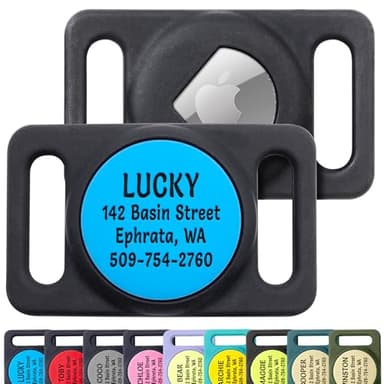
Put the dog’s name on the front and a cell phone number on the back. That is the whole answer, and our top pick for carrying it is a deep-engraved stainless steel ID tag — the cheapest personalized dog gift that does a serious job. This page is for whoever is standing in front of the little text boxes at checkout, whether you are buying the tag for your own dog or engraving one as a gift.
Engraving is final. There is no edit button, no reprint and usually no return, because a tag with someone else’s dog’s name on it cannot be resold. So the five minutes you spend deciding the wording is the most valuable part of the purchase — more valuable than which tag you choose.
Three things decide what goes on it.
One: who reads this tag? A stranger, once, in a hurry, probably on a sidewalk with a nervous dog on the end of their arm. That is the entire readership. It is not a keepsake and it is not a biography — which immediately rules out most of what people are tempted to engrave.
Two: how much room is there? Far less than the checkout box suggests. A hanging tag gives you two faces. A name plate set into a collar gives you a plate. An embroidered collar gives you one short line along the strap. Decide the format first, then write to its capacity.
Three: whose information is it? If this is a gift, you may not have the owner’s phone number, and you should not invent one. A name-only engraving is a perfectly good gift; a wrong number is worse than nothing, because it looks like working identification and is not.
Below are the four ways to carry engraved ID that we would actually give as a gift, ranked, with live prices. Then the wording itself, front and back, and the four things we would leave off.
How much text each format holds
The wording you can use is decided by the format, so compare capacity before you write anything. Every value here is read off the product's own listing.
| Format | How it's marked | Text capacity | Fit |
|---|
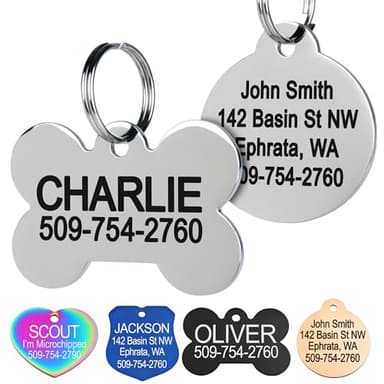
| GoTags engraved ID tag | Deep engraving in stainless steel | Both faces of the tag; multiple shapes and sizes offered | Hangs from any collar ring |
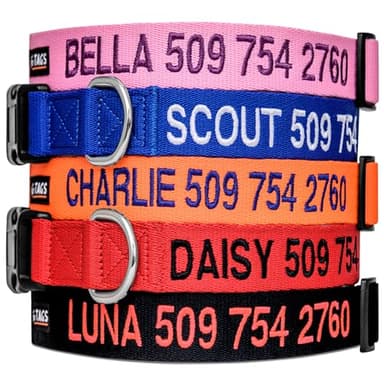
| GoTags embroidered collar | Name and number stitched into the nylon | One short line along the collar, per side | Four sizes, 8 to 26 inch necks |
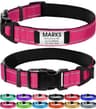
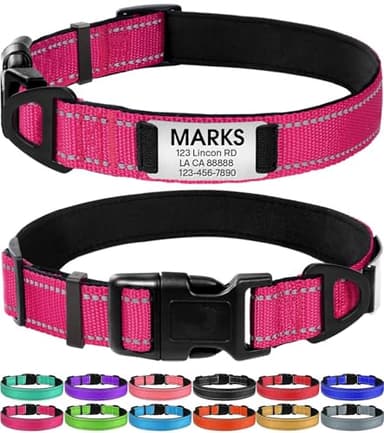
| Joytale name-plate collar | Laser-etched stainless plate set into the collar | A plate's worth — the shortest capacity here | Five sizes, XS to XL |
| GoTags AirTag collar holder | Engraved silicone case that slides onto their collar | Up to four lines of text | Two sizes, for 5/8 inch and 3/4-1 inch collars |
Marking method, text capacity and published size ranges come from each product's Amazon listing. Prices are deliberately not in this table — they render live under each pick, with the date they were read.
The front: the dog’s name
The front of the tag is the dog’s name, in the largest text the tag allows, and nothing else. The reason is practical rather than sentimental: the first thing a stranger has to do with a loose dog is get close enough to hold it, and being able to say the dog’s name out loud is the difference between a dog that comes over and a dog that backs away into traffic.
Use the name the dog actually answers to, not the formal one. Plenty of dogs are registered as something grand and called something short — engrave the short one. And check the spelling with someone in the household rather than assuming, because households spell the same name three different ways and engraving does not forgive a guess.
There is a real counter-argument worth stating. Some owners deliberately leave the name off, on the view that a named dog is easier for a stranger to call away. If that is the owner’s position, the alternative wording is a number on one side and the single word Reward on the other, which gets a phone call without naming the dog. We think the name is the better default for most dogs, but this one is genuinely the owner’s call, and if you are buying a tag as a surprise for someone with strong views about it, engrave the name and let them add a second tag.
The back: one phone number
One cell number, with the area code, and nothing competing with it. A tag with two numbers on it is a tag where neither is readable, and the person reading it is holding a lead in their other hand.
Use a cell, not a landline: the whole point is reaching someone who is currently out looking for the dog. If the household has two phones and you want both covered, that is what a second tag is for — they cost a few dollars and hang on the same ring.
If there is room after the number, the useful additions are short and in this order: the word Microchipped, which tells a finder a vet or shelter can identify the dog even if the tag is lost; a city or town, which helps a finder who is out of the area; or Needs meds, which is the one medical note short enough to be worth engraving and urgent enough to matter. Anything longer than that is a conversation, not a tag.
Formats differ in how generous they are here. The engraved AirTag holder on this page is the roomiest — its listing offers up to four lines, because the case is physically bigger than a tag — while a collar name plate is the tightest and usually fits a name and one number. The embroidered collar is a special case: the name and number are stitched into the strap itself, so there is nothing to jingle and nothing to fall off, which is the whole argument for it.
Four things to leave off
Your home address. This is the one we feel strongest about. The tag is read by a stranger, and a street address tells that stranger exactly where the house is — and, if the dog is out on its own, that there is a reasonable chance nobody is home. A phone number does the entire job of the tag without publishing the house. A town or city is a sensible compromise if the owner wants more than a number.
A long message. “If I am lost please call my mom, she will be so worried” is charming on a mug and useless on a tag. Charming belongs on the gift; the tag is signage.
A medical history. One short flag is useful. A list is not: it will be engraved too small to read, and the person who needs that information is a vet with a chip reader, not a passer-by.
The microchip number itself. It is long, it is hard to engrave legibly, and it is not something a stranger can look up. The word Microchipped carries all the useful information in one word. Keep the number itself in the owner’s paperwork, where it belongs.
Engraving it as a gift, when the dog isn’t yours
An engraved tag is one of the best cheap gifts in this whole category, and giving one has an obvious problem: the useful half of the engraving is someone else’s phone number.
The clean solution is a name-only engraving. It still reads as a personalized gift with their dog’s name on it, it is correct rather than half-right, and most owners will add their own number on a second tag without being asked. Do not use your own number as a placeholder, and do not guess theirs.
If you do have the number, use it and say so. A tag that arrives ready to clip on is a better gift than one that needs a trip to a kiosk. Just be sure it is current — an old number engraved into steel is the exact failure this object exists to prevent.
And consider giving the format instead of the text. The engraved AirTag holder is the clearest example: it slides onto the collar the dog already wears, holds up to four lines of whatever the owner wants, and sidesteps the information problem entirely. Note that the AirTag itself is not included, and that it is only useful to someone already using Apple devices.
For the rest of the name-engraved category — signs, bowls, jars and jewelry that carry a name instead of a photo — our dog name gifts guide is the next read, and personalized dog gifts under $25 covers everything engraved that costs less than a takeaway.
Tag, plate, embroidery or holder: which format to give
A hanging tag is the default and the right answer for most gifts. It fits any dog, it needs no measurement, it costs almost nothing, and deep-engraved stainless steel stays readable long after a stamped tag has rubbed blank against a food bowl. Its only real flaw is noise and the small chance of snagging.
An embroidered collar solves both of those by stitching the name and number into the strap, with nothing hanging off it. The trade is that you need the dog’s neck size, and that embroidery cannot be updated if the phone number changes. The GoTags version publishes four sizes covering 8 to 26 inch necks, which is most dogs.
A name-plate collar sits between the two: a laser-etched steel plate set flat into the collar, silent like embroidery but harder-wearing, in five sizes from XS to XL. It holds the least text of anything here, so write short.
An engraved AirTag holder is the add-on for a household that already has the collar sorted and does not need another one. It is also the only format here with real room for wording.
All three collar formats share one requirement, and it is the thing most likely to ruin the gift: a neck measurement you probably do not have. Read what size dog collar to buy before you order a collar for someone else’s dog, and see our full personalized dog collars roundup for the eight we would give.
Giving the collar too?
Our personalized dog collars guide ranks eight engraved and embroidered collars with their published neck ranges, so you can match the format to the dog — with live prices.