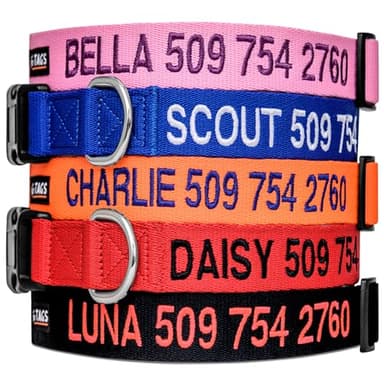
Measure around the base of the neck, buy the size whose published range contains that number, and adjust it so two fingers slide flat underneath. If you cannot measure the dog, our top pick is the GoTags embroidered collar, because four sizes cover necks from 8 to 26 inches — the most forgiving target to aim at from a guess.
This page exists because a personalized collar is one of the best gifts in this category and one of the easiest to get wrong. Once a name is stitched or etched into it, it almost certainly cannot be returned, so the wrong size does not cost you the difference — it costs you the gift.
Three things decide which size to buy, and they are worth working through in order.
One: do you have a number, a guess, or nothing? A measured number means you can buy any collar on this page. A decent guess means you should buy the collar with the widest, most overlapping size ranges. Nothing at all means you should buy something that does not need a size — and that is a good gift too, not a consolation prize.
Two: how does this collar adjust? Two collars with the same published range are not equally forgiving. A side-release buckle with a sliding strap adjusts smoothly across its whole range. A metal prong buckle moves in whole holes, so it lands where the holes are. If you are working from a guess, the sliding strap is the safer bet.
Three: is the dog still growing? A puppy will be out of its first collar within months. That is not a reason to avoid the gift, but it is a reason to know which version of the gift you are giving — the one for now, or the one to grow into.
Below are the collars we would give ranked by how much sizing risk they carry, with their published neck ranges, plus the one pick on the page that cannot be the wrong size. Prices come from the live price layer with the date they were read, not typed in by us.
How to measure a dog’s neck
If the dog is in front of you, this takes thirty seconds. Use a soft tape measure — the fabric kind from a sewing kit, not a builder’s tape — and run it around the base of the neck, where a collar naturally sits: below the jaw, above the shoulders, not up under the ears. Keep it snug against the fur without pulling it tight.
No tape measure? Use a strip of paper or a shoelace, mark where it meets, then lay it flat against a ruler. The number you want is a circumference, not a diameter, and it is almost always larger than people expect, because fur hides a lot of neck.
Then buy the size whose published range contains that number, ideally with room on both sides. A collar that fits on its very first or very last hole is the wrong size even though it does up: there is nowhere left to go when the dog gains a little weight or grows a winter coat.
The fit test afterwards is the two-finger rule: with the collar on, you should be able to slide two fingers flat between the collar and the neck. Looser than that and the dog can back out of it, which is how most loose dogs get loose in the first place. For a dog that already does this, a martingale collar is the design that answers it — the loop tightens just enough when the dog pulls backwards, and the Suncliff version carries the name embroidered in with reflective stitching, in three sizes covering 12 to 24 inch necks.
Five ways to get the size without spoiling the surprise
Read the collar the dog is already wearing. Almost every collar has its size printed or stitched on the inside of the strap, near the buckle. Thirty seconds with the dog on your lap and you have the answer. This is the best method and the one people think of last.
Ask the household, not the owner. A partner, a roommate, a sibling or an adult child can measure the dog or read the label for you, and none of them has to explain why they are asking. This is the fix for almost every personalization problem in this whole category, sizing included.
Ask whoever handles the dog professionally. A groomer, a dog walker, a sitter or a boarding kennel knows the dog’s size, often has it written down, and has no stake in the surprise. If you are buying for someone whose groomer you know, this is a one-text job.
Work from the breed and the age. For a standard, adult, single-breed dog this gets you close enough to pick a size range with confidence. It is weakest exactly where you would expect: mixes, puppies, very fluffy dogs and the dog-that-is-bigger-than-its-breed.
Use photographs, carefully. A photo of the dog next to a person, a sofa or a doorway tells you more than you think about whether you are in small, medium or large territory. It will not give you an inch measurement, so treat it as a way to choose between size ranges, not as a measurement.
If you have tried all five and still have nothing, that is useful information too — it means you should give a gift that does not need a size. Skip to the last section.
Why two collars with the same range aren’t equally safe
The published range tells you what a collar can fit. The buckle tells you how precisely it can land inside that range, and for a gift bought on a guess that second fact matters more.
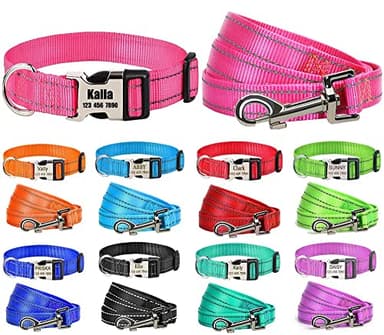
A side-release buckle with a sliding strap — the plastic clip most collars use, including the GoTags embroidered collar and the MOONPET set — adjusts continuously. Anywhere inside the range is reachable, which is exactly what you want when your number is approximate.
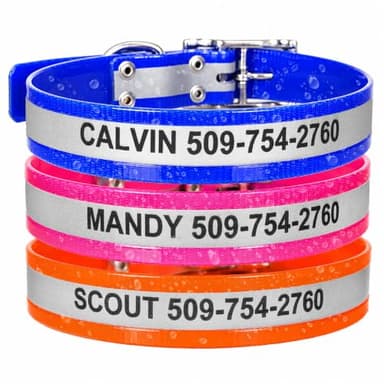
A metal prong buckle — belt-style, as on the GoTags waterproof BioThane collar — moves hole to hole. It is stronger and it looks better, and its six published sizes from 14 to 27 inches are unusually granular, but the adjustment is coarse. Buy it when you know the number; buy a sliding strap when you are estimating.
A martingale is a different shape of problem: it has two loops and needs fitting and supervising, which makes it the right collar for an escape artist and the wrong collar to leave on a dog unattended. Only three sizes are offered, so check the neck range before anything else.
One more trap worth naming: letter sizes. An XS from one maker and an XS from another are often an inch or more apart, which is why the table above lists published inch ranges wherever the maker gives them. Where a collar is sold only as XS to XL — as the Joytale name-plate collar is — the size chart on the listing is the only thing worth reading, and the letter on the box means nothing on its own. The full set of eight is in our personalized dog collars roundup.
Puppies, giants and very small dogs
Puppies are the hardest case, because the right answer changes while the box is still in the mail. A puppy will outgrow its first collar in months, so you are choosing between a collar for now, which is temporary by design, and a collar for later, which is a strange thing to unwrap. If the gift has to land on the day, our new puppy gifts guide leans toward presents that do not expire, and an engraved tag or a name sign does the personalized job without a measurement.
Giant dogs fall off the end of most size charts. The MOONPET set goes to a published 28 inches, which is the longest range on this page; most other collars stop short of that. Check the top of the range before anything else, because a collar that is too small for a giant is the one sizing error that cannot be adjusted out.
Very small dogs have the opposite problem: hardware weight. The MOONPET set starts at a published 7.8 inches and the GoTags embroidered collar at 8, so both reach genuinely small necks, but a heavy metal buckle and a hanging tag are a lot of furniture on a four-pound dog. For the smallest dogs, embroidery or an etched plate — which add no weight at all — beat a tag.
What to give when you genuinely cannot get a size
This is the most useful part of the page, because it is where most gift buyers actually are.
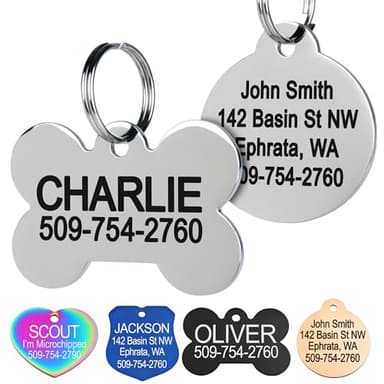
An engraved ID tag. It fits any dog with a collar ring, it costs a few dollars, and deep-engraved stainless steel stays readable long after a stamped tag has rubbed blank. It is the only pick on this page that cannot be the wrong size. What to put on it is its own decision — see what to engrave on a dog tag.
An engraved AirTag holder. It slides onto the collar the dog already wears, takes up to four lines of engraved text, and needs no neck measurement — only the width of their existing collar, which is a far easier thing to establish. The AirTag itself is not included.
Something with the name on it that is not worn at all. A name sign for above the crate, an engraved treat jar, a personalized bowl: all of them put the dog’s name into the house with nothing to fit. Personalized dog bowls and personalized dog treat jars are the two guides to read, and personalized dog gifts under $25 collects the cheap versions of all of it.
Or give the collar as a voucher for the collar. Unromantic but honest: wrap the tag, say the collar is coming once you know the size, and let them tell you. A gift that fits beats a gift that surprises.
Ready to pick the collar?
Our personalized dog collars guide ranks eight embroidered, engraved and name-plate collars with their published neck ranges and buckle types — with live prices on every pick.