The leash is still on its hook. The ashes have come home, or they will soon. And somewhere in the middle of it you have started thinking about the people at the clinic — the vet who explained everything slowly, the technician who stayed in the room, the person at the front desk who knew your dog’s name. You want to thank them, and you are not sure whether that is a normal thing to do.
It is, and it is welcomed. Veterinarians say the cards they receive cluster around exactly this moment. An emergency veterinarian in Ohio with fifteen years in ER practice told Clinician’s Brief that the most thank-you cards they ever get come after euthanasia — “hundreds,” against “like 5” for saving a dog’s life. A New Jersey veterinarian interviewed by dvm360, who follows each euthanasia with a phone call or a sympathy card of her own, described being taken aback by the number of thank-you cards she receives.
It matters more than it may look from your side of the table. dvm360 describes performing euthanasia as “one of the most emotionally taxing responsibilities” in veterinary medicine, and the AVMA’s wellbeing guidance lists euthanasia among the repeated hard experiences that can lead to compassion fatigue. The same guidance notes that the work also rewards people with what it calls compassion satisfaction — “a joy or sense of achievement found in helping and caring for others.” A card is one of the few ways that second part ever gets said out loud. As Fear Free’s guide for pet owners puts it: “Vets hurt too. A card thanking the vet for his or her compassion can go a long way.”
The card is the gift. Everything else on this page is optional. Not One More Vet, a nonprofit that supports veterinary professionals through peer support, resources and education, gives pet owners a short list of ways to help their clinic, and “send thank you notes to staff members who’ve helped you” is on it. A card can also outlast the week it arrives: a licensed veterinary technician writing for the veterinary education site VETgirl suggested clinics keep every client thank-you note, card and picture together in a book in the break room. “That way, we remember why we love what we do!”
If you want to send something with it, make it something the team can share. A euthanasia is rarely one person’s work. A veterinarian quoted by dvm360 described its emotional weight reaching “from front-desk personnel to the veterinarian, the veterinary technician and auxiliary staff.” That is why the classic clinic thank-you is edible: Fear Free’s guide notes that a box of chocolates or cookies given to your vet gets shared with the rest of the hospital staff, and that flowers cheer up the office or the lobby. A framed photo of your dog is another idea from the same guide — “Pictures are nice, because when you look at them years later, you remember what you did for that pet,” the small-animal veterinarian it quotes explained. And if you would rather the money did something, a donation in your dog’s name to a veterinary school or an animal-health foundation can send your vet a card telling them so. There is more on each of these below.
What to look for in anything you add. Keep it small, keep it shareable or useful on a shift, and make sure it asks nothing of anyone — no reply, no wall space, no decision about whose desk it lives on. Be careful with vet-themed merchandise in particular. Plenty of it is built on clinic in-jokes about catheters, veins and chaotic shifts, which are affectionate inside a treatment room and land very differently coming from a family whose dog has just died. Our gifts for vets and vet techs guide covers everyday thank-yous for clinic staff; this page is only about the one that comes after a loss.
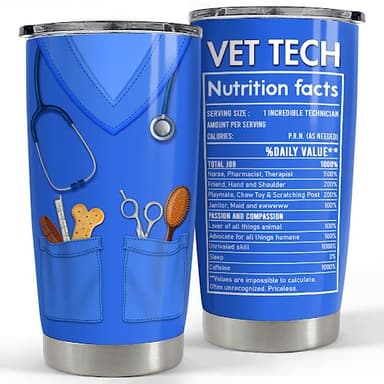
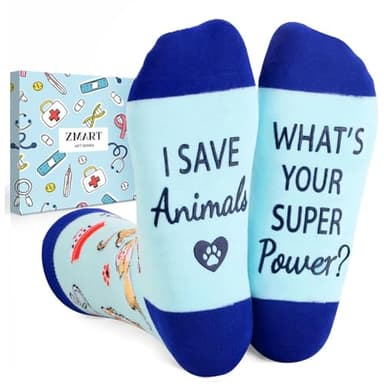
Which is why the two picks below are modest, deliberately. The first is an insulated tumbler made for vet techs. When we checked the listing, its printed “nutrition facts” joke was about how much a technician gives — compassion, skill, a hand and a shoulder — rather than about the grim side of the job, which makes it the one piece of vet-tech merchandise we would be comfortable sending now. It suits the technician who was in the room. The second, novelty socks for vets and techs, is a team-sized fallback: small, worn under scrubs, easy to buy for several people. Read the slogan before you order — the listing’s default design says “I save animals,” and some owners will find that sits oddly right now. If neither feels right, skip them both. The card is enough.
What to write in the card
The formula is short: use your dog’s name, use the vet’s or technician’s name if you know it, and name one specific thing they did. The specific thing is the whole card. Vets who do this work talk about the small details as the part they can control. Dr. Mary Gardner, a cofounder of Lap of Love Veterinary Hospice, listed some of them for dvm360: the way the phone is answered, how the procedure is explained, keeping the pet in the room rather than taking them to the back, and even “how we write our sympathy cards.” Another veterinarian, interviewed by Clinician’s Brief, described it as “just saying the pet’s name or putting your hand on their shoulder.” If you noticed one of those small things, write it down. It tells them it worked.
Everything below is written to be copied and changed. Swap in the names, adjust a word until it sounds like you, and stop after two or three sentences.
For a vet who knew your dog for years
Long relationships are the ones vets describe as hardest to end. A veterinarian interviewed by dvm360 described leaving the room and locking himself in the office after euthanizing “the ones you’ve nursed for years and years.” Your card can hold the whole span of it — the puppy visits as well as the last one.
- “You met Biscuit when he was nine weeks old, and you were there at the end. Thank you for every appointment in between.”
- “Thank you for eleven years of looking after Millie, and for being honest with us when it was time. We trusted you because you had always been straight with us.”
- “You always got down on the floor to say hello to him first. You did that on the last day too, and we noticed.”
- “We couldn’t have made that decision without you. Thank you for helping us see it clearly, and for never rushing us.”
- “Thank you for taking such good care of Rosie — and of us. She was lucky to have you as her vet.”
For an emergency or after-hours vet
An emergency vet usually meets your dog on its worst night. The Ohio ER veterinarian quoted above put it plainly: “I haven’t been seeing this 16-year-old dog since it was a puppy.” In the same interview they said they rarely go a shift without at least one euthanasia. So the kindest card to an ER team does two things: it thanks them for the night, and it tells them who your dog was the rest of the time — the part they never got to see.
- “You only met Scout on the worst night of his life, so I wanted you to know who he was: fourteen years of stolen socks and beach walks. Thank you for making his last hour calm.”
- “Thank you for seeing us in the middle of the night, and for explaining everything twice when I couldn’t take it in the first time.”
- “We were strangers to you that night, and you treated her as if she were yours. Thank you.”
- “Thank you for letting us stay with him as long as we needed. We will never forget how kind the whole team was.”
- “We know you see nights like ours all the time. It didn’t feel like routine to us, and that was because of you.”
For a vet who came to your home
Vets who do home euthanasia sometimes describe those visits in very personal terms. A veterinarian who splits their time between a clinic and a mobile euthanasia practice told Clinician’s Brief about a client who, once it was all over, invited them to sit at her kitchen table and share an ice cream bar: “That was a really special experience.” In Loving Arms, an in-home euthanasia service in Napa, publishes a page of families’ letters of appreciation, and what those letters thank the vets for is strikingly concrete — a favorite bed, treats that had always been off-limits, the calm of being at home. Write down the concrete thing.
- “Thank you for letting Daisy go on her own bed, in her own sunny spot. It was exactly what she would have wanted.”
- “You were gentle with her and gentle with us, and you never once made it feel hurried.”
- “Thank you for kneeling on our kitchen floor for as long as it took. The kids still talk about how kind you were.”
- “He was frightened of the car and frightened of the clinic. Because of you, he didn’t have to be frightened at the end.”
For the technician who was in the room
Technicians carry this work too. The ER vet quoted above credited their clinic’s techs with placing catheters for euthanasia appointments (“Our techs are amazing at it”), and a registered veterinary technician with thirteen years in practice told Clinician’s Brief that they now see euthanasia as giving the pet a gift — but added, “It’s still taking a life, so there is a toll.” Not One More Vet is explicit that when it talks about veterinary professionals it means everyone, technicians and support staff included. If you write one card to the doctor, consider a second for the technician by name.
- “Thank you for staying with Pepper the whole time. I will always remember how gently you held her.”
- “You got her settled so quietly that she never even looked worried. Thank you.”
- “Thank you for the blanket, the soft voice, and for tearing up a little with us. It helped more than you know.”
- “You made a hard job look like kindness. Thank you for looking after Max, and after us.”
For the front desk, or the whole team
The front desk carries a lot on a day like that — the call to book it, the waiting room, the paperwork. A card addressed to everyone at the clinic and left at reception reaches the people you didn’t get to thank by name.
- “To everyone who looked after Bear over the years: thank you. You made the hardest day as gentle as it could possibly be.”
- “Thank you for the quiet room, the extra time, and for knowing her name at the desk on every single visit.”
- “To the whole team — she always tugged toward your door, which for a vet’s office says everything.”
Short lines to close a card
- “With gratitude, from all of us — and from Biscuit.”
- “Thank you for being there for him, and for us.”
- “No need to reply. We just wanted you to know.”
- “You did right by her. Thank you.”
Two practical notes. A short card that arrives beats a perfect one that never gets written, so don’t wait for the right words. And keep the card for thanks only — if something about the last day is still bothering you, that deserves its own conversation. If you are on the other side of this and writing to a friend whose dog has died, our guide to what to write in a pet sympathy card has wording for that, and what to say when someone loses a dog covers the conversation in person.
What to skip
Anything built on clinic humor. Vet-tech gift listings are full of jokes about catheters, veins and chaotic shifts. Between colleagues they are affectionate. From a grieving family, they read as if you misunderstood the day. If a design would feel wrong to you this week, it will feel wrong to them too.
Questions or complaints tucked into the card. If something about the last day is bothering you, ask for a time to talk it through, on the phone or at the clinic. A thank-you that turns halfway into “but I wondered why…” leaves the reader unsure which message to answer.
Messaging your vet personally. It is tempting to find your vet on social media and write there. Send it through the clinic instead. Not One More Vet warns that contacting veterinary professionals with “quick questions” in their time off adds to the poor work-life balance many of them report, and the same instinct applies to thanks: a card at the clinic arrives during working hours and can be read when they are ready.
An expensive gift for one person. A big personal present can put the recipient in an awkward spot with the rest of the team, and it isn’t what the moment calls for. If you want to spend more, spend it on the team or on a donation. The most generous story in the Fear Free guide is of a client who had just lost her dog and gave the hospital a television for its waiting room, so other clients had something to watch while they waited for news of their own pets — a gift for the next family rather than for any one person.
Anything that has to be displayed. A small framed photo is lovely, and the vet quoted by Fear Free spoke warmly of them. A large engraved plaque asks the clinic to find wall space and keep it there forever. Choose things that can be shared, eaten, used, or tucked into a drawer with the other cards.
Waiting until it feels perfect. “Thank you for being so kind to Biscuit and to us” is a complete card. So is a photo with his name written on the back.
Looking for ways to remember your dog?
Our memorial ideas guide starts with the free ones — printing photos, planting something, writing it down — before any keepsakes.